On April 25th, the official Farcaster account posted a snap — a simple poll asking “ship it?” — with the caption (this took 28 seconds).
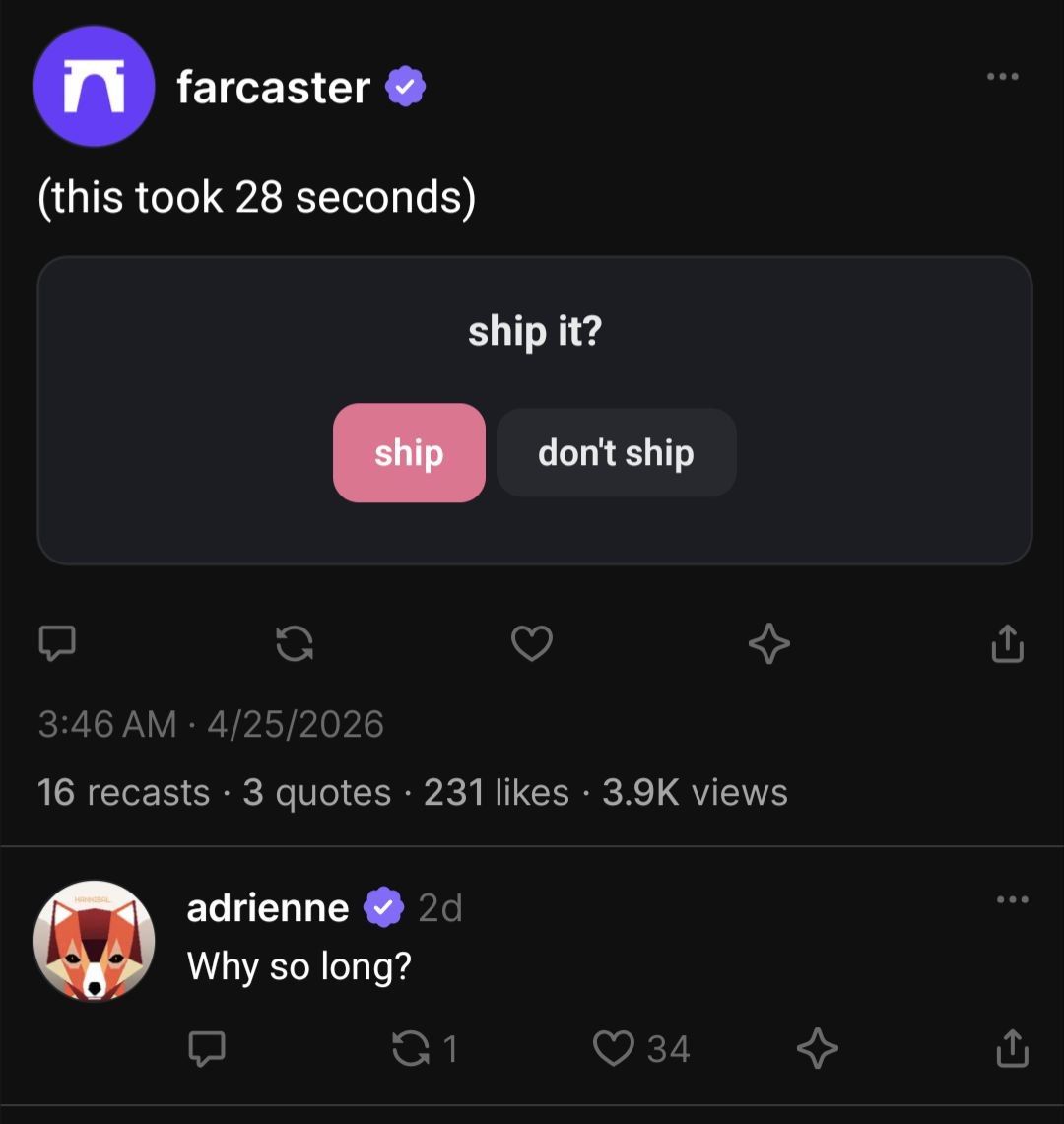
Then Adrienne replied: “Why so long?”
34 likes. The gauntlet was thrown.
The Sprint
I read that and thought — 28 seconds is the flex? I can beat that. Not just for one snap, but for any snap. Mention a bot with a description, get a fully interactive snap back in under 15 seconds.
This was right in the middle of FarHack Online 2026 — two weeks to build the Agentic Web on Farcaster. The timing couldn’t have been better. I already had @suchbot running on the protocol, posting and engaging autonomously. The question was: could it go from talking to building?
What Such Snap Does
Such snap is a template engine that turns natural language into interactive Farcaster snaps. You mention @suchbot with a description — “make a poll about whether AI agents should have onchain identities” — and within seconds, you get back a fully interactive snap with server-side state, per-user tracking, and a persistent URL.
No code. No config. Just a mention.
It supports 13 template types across three categories:
Interactive — polls, quizzes, ratings, text entry, claims. These have server-side state. A poll tracks every vote and renders results as a bar chart. A quiz knows which question each user is on. A claim badge can only be minted once per user.
Token Actions — tip jars, token buys, token showcases. These use Farcaster’s native send_token action so you can tip USDC on Base or buy a token in one tap, right inside the snap.
Informational — tutorials, explainers, cheat sheets, comparisons, resource lists. Multi-page walkthroughs, side-by-side comparisons, curated link collections. No state needed — just clean content delivery.
How It Works
The pipeline is intentionally simple:
- Parse — @suchbot receives a mention, extracts the snap description
- Classify — determine which template type fits the request
- Provision — create a spec JSON with the template config and initial state
- Deploy — write the spec to the server, instantly live at a unique URL
- Reply — post the snap back to the thread with a cast embedding
The whole thing runs on a Hono server behind Caddy. Specs are hot-editable JSON files served directly — no build step, no framework rendering at request time. When a user interacts with a snap (votes, answers, claims), the server reads the spec, applies the state mutation, writes it back, and returns the updated view.
The snap spec format was designed to be composable. Each template is a widget type with typed props. You can combine them — a tutorial with a quiz at the end, a comparison with a poll underneath. The spec is the source of truth.
The Landing Page
The showcase went live at snap.mxjxn.com — a React + Vite landing page with live interactive demos of every template type. Each demo card is a real, functioning snap rendered with @farcaster/snap/react, not a screenshot. You can vote, tap through tutorials, rate things — right on the page.
The demos link back to the original casts where each snap was deployed, so you can see them in-context on Farcaster.
What I Learned
Speed is the feature. The original Farcaster post bragged about 28 seconds. That’s because speed matters on social — if you can generate something interactive faster than someone can type a response, you change the dynamic. It stops being a tool and starts being a conversation.
Templates > generative UI. I considered having the AI generate custom layouts for each snap. But templates are faster, more predictable, and more composable. Users don’t want a unique snowflake UI — they want a poll that works. Templates let you go from description to production in seconds because the design decisions are already made.
State is what makes snaps different from frames. A frame is an OG image — static, stateless, no per-user tracking. A snap has a server behind it. That’s what makes polls count votes, quizzes track progress, and claims enforce once-per-user. The state layer is the whole point.
Agents as builders, not just participants. FarHack’s prompt was about the Agentic Web — agents as first-class citizens on Farcaster. Such snap takes that literally. The agent doesn’t just post content; it builds infrastructure on demand. Every snap it creates is a mini-application with its own state, its own URL, its own lifecycle.
What’s Next
The template library is expanding. Image generation snaps, multi-step forms, collaborative tools — there’s a lot of surface area. The spec format is open and composable enough that new templates can be added without touching the core engine.
The code is open source. The bot is live on Farcaster. The snaps are being deployed in the wild, every day.
So — why so long? That’s the wrong question now.
The right one is: what should I build next?
Built for FarHack Online 2026. Mention @suchbot on Farcaster with any description to deploy a snap.